
Lithium battery charging and protection integrated circuit board for 3.7V batteries, 5V input micro USB, 1000mA max charging current with over-discharge and overcurrent protection, blue PCB measuring 2.6 x 1.7 cm.


Lithium battery charging and protection integrated circuit board for 3.7V batteries, 5V input micro USB, 1000mA max charging current with over-discharge and overcurrent protection, blue PCB measuring 2.6 x 1.7 cm.
Integrated Lithium Battery Charger and Protection Board with 5V USB Input and 3A Safety Circuit

This single printed circuit board combines the essential functions required for safely managing a 3.7V lithium-ion or lithium-polymer battery. It serves as both a charging module, accepting 5V power via a standard micro USB port, and a comprehensive protection circuit to guard against common battery faults. Designed for makers, electronics hobbyists, and small-scale device integrators, it eliminates the need for separate charging and protection components, simplifying project builds. Its defined specifications, including a 1000mA max charge current and specific protection thresholds, provide clear parameters for incorporating it into portable power banks, DIY gadgets, or backup power systems where reliable battery management is crucial.
Features and Construction
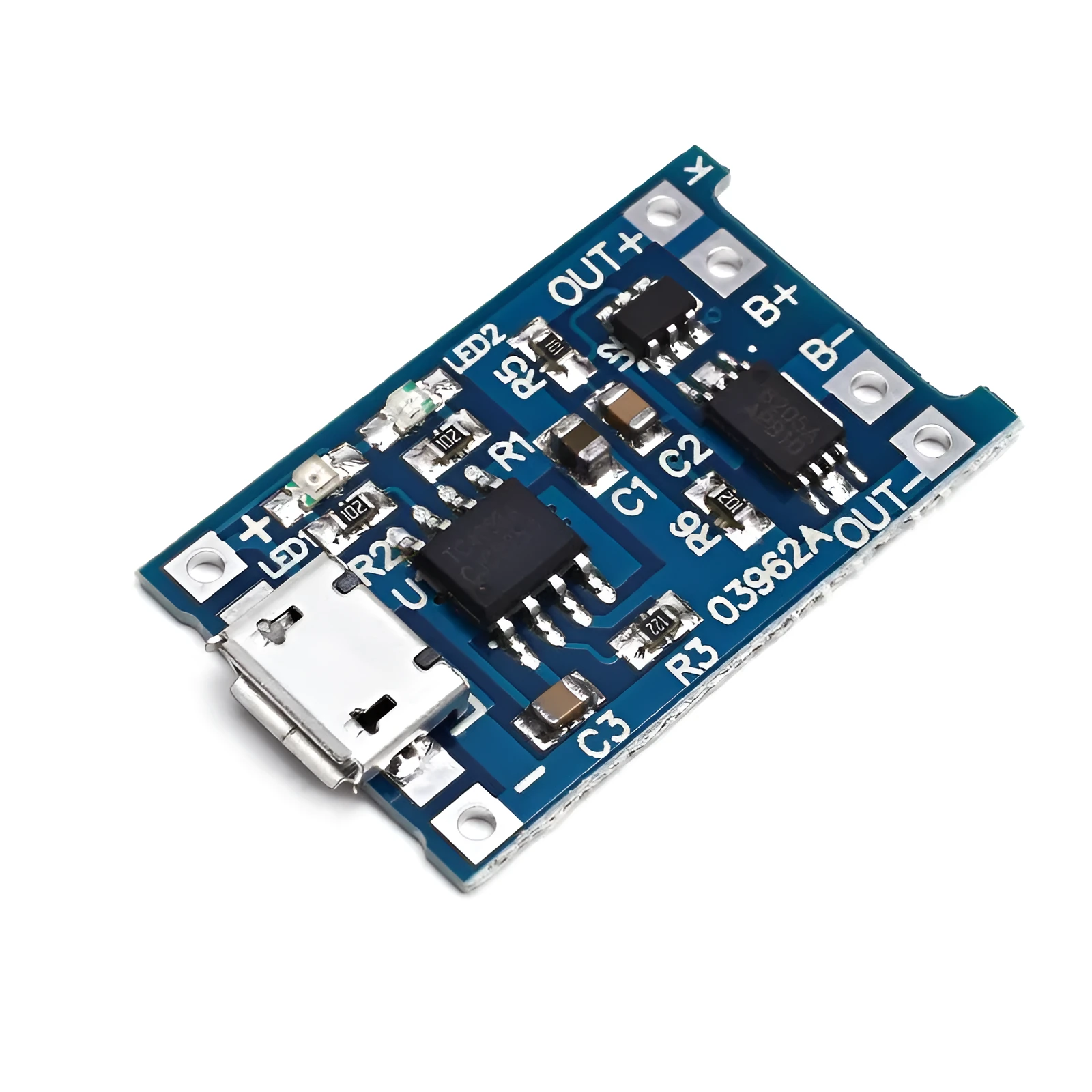
This board is defined by its integrated functionality and specific electrical ratings, all contained on a small, colour-coded PCB.
Material and Build
The board is constructed on a standard fibreglass substrate, with the circuit pattern formed by copper traces and covered by a blue solder mask. It uses surface-mount technology (SMT) for its components, which include the charging IC, protection IC, MOSFETs for switching, and supporting passive components like resistors and capacitors. This manufacturing approach contributes to the board's compact profile and is typical for cost-effective, mass-produced electronic modules. The blue colour aids in visual identification, and the board includes labelled solder pads or through-holes for connecting the battery, load, and USB input.
Size and Practical Fit
The physical dimensions are precisely 26 millimetres in length and 17 millimetres in width (2.6 x 1.7 cm). This small footprint is a key practical differentiator, allowing it to be fitted into tight spaces within electronic enclosures. When planning a project, users must account for this area as well as the minimal height of the mounted components. The size makes it suitable for embedding into custom battery packs, small robotics, handheld instruments, or any application where internal space is limited and a dedicated, off-the-shelf battery management solution is required.
Uses and Placement

The board's defined electrical characteristics make it suited for specific project types and user scenarios, from prototyping to final product integration.
Event or Professional Use
For electronics workshops, prototyping labs, or small-scale manufacturing, this board serves as a reliable, pre-designed component. It can be used to quickly add safe battery charging capabilities to demonstration units, test rigs, or low-volume electronic products without investing in custom circuit design. Its standard 5V USB input means it can be powered from ubiquitous phone chargers, power banks, or computer ports, simplifying logistics. The integrated protection provides a safety margin during development and testing, guarding against accidental short circuits or deep discharge that could damage expensive battery cells during evaluation.
Everyday Home Use
For DIY enthusiasts and makers at home, this board is a practical solution for reviving or constructing battery-powered devices. Common projects include building custom USB power banks, creating battery backup systems for Raspberry Pi or Arduino projects, or repairing older gadgets with failed battery management circuits. The clear voltage and current specifications allow users to match it appropriately with their chosen 3.7V battery cell, ensuring compatible operation. Its ready-to-use nature reduces the complexity and potential hazards of working directly with bare lithium cells, making battery-related DIY projects more accessible to intermediate hobbyists.
Benefits and Buying Value

The value of this integrated board lies in its combination of functions, specified safety features, and the practical convenience it offers for certain types of projects.
Reuse and Low Maintenance
As a solid-state electronic module with no moving parts, it requires no routine maintenance. Its primary value for reuse comes from its role as a permanent component within a finished device, providing ongoing battery management throughout that device's lifespan. If a project is decommissioned, the board can potentially be desoldered and reused in another application, provided it has not been damaged. Its durability is linked to the quality of its soldered joints and component ratings; operating it within its specified 5V input and 3A limits is the best practice to ensure long-term functionality.
Why Choose This Product
Choosing this specific board is justified when your project requires a known, off-the-shelf solution for charging and protecting a single-cell 3.7V lithium battery via USB. Its concrete differentiators are its integrated design (charger + protector), its clearly stated protection thresholds (2.5V discharge, 3A overcurrent), and its compact, measurable size of 26x17mm. It is a fit-for-purpose component for those who need these specific parameters and wish to avoid sourcing and wiring separate ICs. The value is in the time saved and the reduced complexity for the end-user, provided the electrical specifications align perfectly with the intended battery and load.